NyQuil typically kicks in within 15-30 minutes after you take it, with peak effects hitting around 1-2 hours. You’ll experience symptom relief from acetaminophen and dextromethorphan for 4-6 hours, but the sedative ingredient doxylamine lasts considerably longer, up to 8 hours. This mismatch explains why you might feel groggy after your cold symptoms improve. Understanding the factors that influence these timelines can help you time your dose effectively.
How Long Does It Take for NyQuil to Kick In?
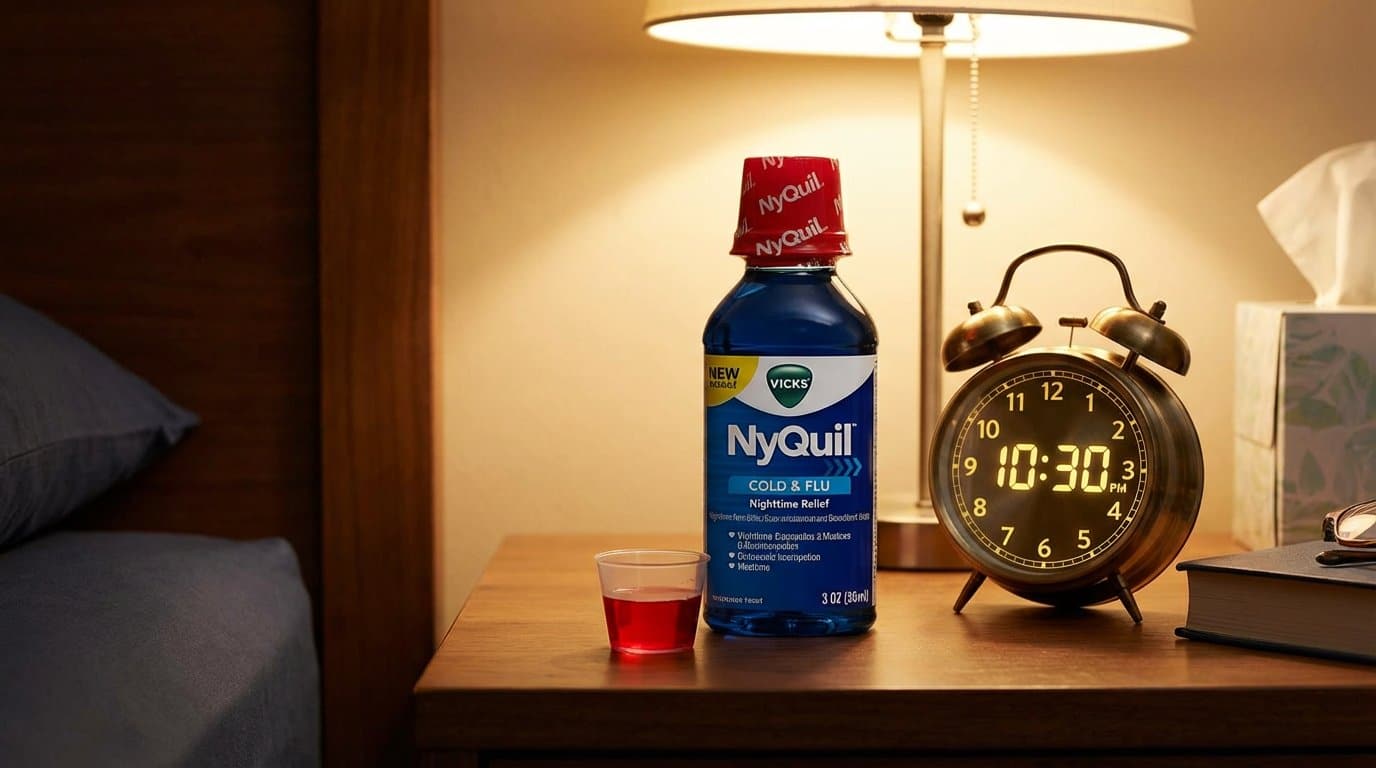
How quickly can you expect NyQuil to start working? The typical NyQuil onset time ranges from 15 to 30 minutes after you take your dose. Most people feel the sedative effects within 30 minutes of ingestion.
Your body absorbs the active ingredients, doxylamine succinate, dextromethorphan, and acetaminophen, relatively quickly. Doxylamine, the antihistamine responsible for drowsiness, begins slowing brain activity within this onset time window.
You’ll reach peak effects within one to two hours after taking NyQuil. Understanding how long does NyQuil make you sleepy helps you plan your dose timing effectively. The total duration of NyQuil’s effects lasts approximately 4-6 hours, though some residual drowsiness may persist longer.
Several factors influence your individual response, including your metabolism speed, dosage amount, and overall health status. You should avoid activities requiring alertness once you’ve taken your dose. If your symptoms do not improve after 30 minutes, do not take an extra dose as overdosing on NyQuil can be dangerous.
When NyQuil Works Best
Timing your NyQuil dose correctly maximizes symptom relief while you sleep. NyQuil begins working within 30 minutes, so take it shortly before bedtime. The nighttime administration benefits include aligning peak effectiveness with your sleep hours, when rest supports recovery. using nyquil as a sleep aid can help ease the transition into a restful night. Many people find that the calming effects enable them to drift off more easily and stay asleep longer.
Understanding when NyQuil works best helps you avoid next-day grogginess. How long NyQuil drowsiness lasts depends on individual metabolism, but effects typically persist for six hours. NyQuil is designed to treat symptoms including cough, sore throat, and fever that commonly disrupt nighttime rest. The active ingredient doxylamine succinate helps you get a good night’s sleep while relieving your symptoms.
| Factor | Recommendation |
|---|---|
| Onset time | 30 minutes before bed |
| Effect duration | Approximately 6 hours |
| Dosing interval | Every 6 hours |
| Maximum daily doses | 4 doses |
| Morning activities | Avoid driving until drowsiness clears |
You’ll achieve ideal results by reserving NyQuil exclusively for evening use when alertness isn’t required.
How Long NyQuil Relief Really Lasts

While knowing when to take NyQuil optimizes your sleep quality, understanding the actual duration of relief guarantees you don’t redose too early or expect effects to last longer than they do. The pharmacokinetics of NyQuil’s active ingredients determine your relief window.
Acetaminophen and dextromethorphan provide symptom relief for four to six hours, covering pain, fever, and cough suppression. However, doxylamine’s drug half-life extends drowsiness up to eight hours, meaning sedation outlasts other effects. For elderly individuals, the sedative effect can last significantly longer than in younger adults.
This mismatch in medication timing explains why you might still feel groggy after symptoms return. You’ll experience peak relief within the first six hours, but full wear-off requires eight hours minimum. Don’t exceed four doses within 24 hours, and space each dose at least six hours apart to maintain safe, effective coverage. If symptoms persist beyond two weeks of use, you should consult a healthcare provider for further evaluation.
Why NyQuil Drowsiness Lasts Longer Than Cold Relief
Doxylamine consistently outlasts NyQuil’s other active ingredients because its 10-hour half-life far exceeds the four-to-six-hour relief window of acetaminophen and dextromethorphan. This mismatch explains why you’ll wake without congestion or cough but still feel groggy.
The nyquil duration of effects for sedation extends well beyond symptom control. While pain and cough relief fade by early morning, half the doxylamine remains in your bloodstream. This creates the characteristic “NyQuil hangover”, reduced alertness, slowed reaction times, and impaired concentration that persist into your morning routine. The sedation you experience comes from doxylamine blocking histamine receptors rather than promoting the restorative sleep your body actually needs.
Understanding how long before bed to take nyquil helps minimize next-day sedation. The nyquil wear off time depends on your metabolism, age, and liver function. Older adults and those with slower clearance rates experience prolonged grogginess, making timing particularly important for maintaining morning alertness. The sedative effects typically begin within 30 minutes of taking NyQuil, so plan your dose accordingly to maximize both symptom relief and sleep quality.
NyQuil Liquid vs. LiquiCaps: Which Works Faster?
Beyond timing your dose, the formulation you choose also affects how quickly relief begins. NyQuil liquid absorbs faster through your stomach lining, while LiquiCaps require the capsule shell to dissolve first. Despite this difference, both forms typically produce drowsiness within 30 minutes, with full effects developing within one hour.
When considering how long does NyQuil last, both formulations provide comparable duration, approximately six hours for symptom relief and up to eight hours for drowsiness. Liquids enter your bloodstream more rapidly, whereas LiquiCaps deliver a steady release once the shell breaks down. The drowsiness you experience is primarily caused by doxylamine succinate, one of the most powerful over-the-counter antihistamines available. This ingredient works by blocking histamine, a chemical that normally helps your body stay awake and alert.
For ideal results, take either form 30 minutes before bedtime. Adults should follow dosing instructions: use the provided measuring cap for liquid or take two LiquiCaps every four hours as directed. Neither form demonstrates a clinically significant speed advantage.
Factors That Change How Fast NyQuil Works
Several factors influence how quickly NyQuil takes effect in your body. Taking NyQuil on an empty stomach speeds absorption, allowing the medication to enter your bloodstream faster than when taken with food. Your individual metabolism rate and body weight also play significant roles in determining onset time, with faster metabolisms and lower body weights typically experiencing quicker effects. Age is another consideration, as you should speak with a doctor before taking NyQuil if you are over 75 years old. Additionally, NyQuil should only be given to children over 6 years old, so always check age guidelines before administering this medication.
Empty Stomach Speeds Absorption
When you take NyQuil on an empty stomach, absorption rates increase substantially for certain active ingredients. Acetaminophen and phenylephrine absorb faster without food, potentially accelerating onset by up to 30 minutes. However, dextromethorphan and doxylamine show minimal absorption differences regardless of meal timing.
| Ingredient | Empty Stomach Effect | Clinical Significance |
|---|---|---|
| Acetaminophen | Faster absorption | Quicker pain relief |
| Dextromethorphan | No change | Consistent cough control |
| Doxylamine | No change | Steady sedation onset |
For ideal timing, you’ll want your stomach empty approximately two hours after eating. Liquid NyQuil formulations demonstrate the quickest onset under these conditions. While faster absorption accelerates relief, it also means quicker elimination from your system. This timing consideration matters when you’re calculating how long effects will last through the night. For most people, NyQuil’s effects last around six hours, so planning your dose timing becomes essential for uninterrupted sleep. Despite these absorption differences, studies show that overall analgesic activity is not significantly affected by whether you take NyQuil with or without food.
Metabolism Rate Matters
Your body’s metabolic rate directly determines how quickly NyQuil’s active ingredients process through your system. Liver function plays the primary role, your liver’s CYP enzymes break down acetaminophen, dextromethorphan, and doxylamine. If you have impaired liver function, metabolism slows considerably, extending effects well beyond the typical 4-6 hour window.
Age affects your processing speed greatly. If you’re over 65, expect intensified effects lasting 8-12 hours rather than the standard duration. Your genetic makeup also matters, poor CYP2D6 metabolizers retain dextromethorphan up to 72 hours, while genetic polymorphisms can extend doxylamine’s sedation to 8-12 hours.
Hydration status influences your clearance rate too. Dehydration may hasten onset but prolongs drowsiness severity. Maintaining proper hydration supports standard elimination timing and helps your body process NyQuil within expected parameters. Body weight also plays a role, as metabolism, body weight, and hydration status collectively influence how quickly you begin feeling NyQuil’s effects after ingestion.
Body Weight Affects Timing
Body weight directly influences how quickly NyQuil’s active ingredients reach peak concentration in your bloodstream. If you weigh more than the average 150-200 lb adult, expect onset beyond the standard 15-30 minutes. Lighter individuals absorb doxylamine succinate faster, intensifying drowsiness effects sooner.
Duration also shifts based on your body mass. Higher body weight extends effects to 6+ hours, while lighter frames typically experience a 4-hour window. Doxylamine’s half-life lengthens in obese patients, meaning morning grogginess becomes more likely.
The standard 30 mL dose assumes average adult weight. If you’re heavier, you may notice diminished symptom relief. Lighter users face intensified side effects from that same dose. Acetaminophen peaks later in those with higher body fat percentage, while doxylamine-induced drowsiness follows similar delayed patterns.
How Long Until NyQuil Fully Wears Off?
You can expect NyQuil’s sedative effects to last approximately eight hours, though individual metabolism and dosage size directly influence this timeline. Factors like body weight, liver function, and whether you’ve taken other medications can either speed up or slow down elimination from your system. If you’re still feeling groggy the next morning, you shouldn’t drive or operate machinery until the drowsiness completely clears. You can expect NyQuil’s sedative effects to last approximately eight hours, though individual metabolism and dosage size directly influence this timeline. Factors like body weight, liver function, and whether you’ve taken other medications can either speed up or slow down elimination from your system, dynamics that help explain can nyquil be habit forming when it’s used repeatedly for sleep rather than short-term illness relief. If you’re still feeling groggy the next morning, you shouldn’t drive or operate machinery until the drowsiness completely clears.
Typical Eight-Hour Timeline
Most users find that NyQuil’s effects follow a predictable eight-hour timeline from dose to clearance.
During the first 30 minutes, you’ll notice drowsiness setting in as doxylamine takes effect. Symptom relief builds quickly, with full effectiveness reaching its peak between hours one and six. This window represents your maximum therapeutic benefit, cough suppression, pain relief, and sedation work together at their strongest.
Between hours six and eight, you’ll feel the primary effects diminishing. Core symptom control fades, and most active ingredients clear your system.
However, don’t assume you’re fully clear at the eight-hour mark. Residual sedation from doxylamine can linger until hour 12. You should avoid driving or operating machinery during this extended window, even if other symptoms have resolved.
Factors Affecting Elimination
Several individual factors determine how quickly NyQuil clears your system, with metabolism rate playing the central role. Faster metabolizers eliminate active ingredients sooner, while slower metabolisms extend clearance beyond the standard 4-6 hour window.
Your genetic makeup dramatically influences elimination time. CYP2D6 enzyme variants can extend dextromethorphan elimination from 3 to 30 hours, with poor metabolizers retaining traces up to 72 hours. Liver enzyme polymorphisms may prolong doxylamine’s sedative effects to 8-12 hours.
Age and liver function also affect duration. Older adults typically experience extended sedative effects due to slower metabolism. Compromised liver function delays clearance since your liver processes all NyQuil components.
Dosage matters immensely. Exceeding four doses within 24 hours prolongs wear-off time. Taking NyQuil on an empty stomach accelerates onset but may speed elimination. Dosage matters immensely. Exceeding four doses within 24 hours prolongs wear-off time, and Taking nyquil every night to sleep increases the risk of tolerance, side effects, and next-day grogginess. Taking NyQuil on an empty stomach can accelerate onset but may also speed elimination, leading to uneven effects and disrupted sleep quality.
Next-Day Grogginess Risks
While NyQuil’s symptom relief typically fades within 4-6 hours, doxylamine’s sedative effects persist noticeably longer, often 6-12 hours after your dose. This mismatch creates the characteristic “NyQuil hangover”, that groggy, mentally foggy feeling when your alarm sounds.
| Time Post-Dose | Symptom Relief | Sedation Level |
|---|---|---|
| 0-4 hours | Active | Strong |
| 4-6 hours | Fading | Moderate |
| 6-8 hours | Minimal | Present |
| 8-12 hours | None | Lingering |
| 12+ hours | None | Clearing |
If you’re experiencing persistent drowsiness beyond 8 hours, active medication remains in your system. You should avoid driving or operating machinery until effects fully clear. To minimize morning grogginess, dose at least 6 hours before your intended wake time.
How to Avoid NyQuil Grogginess the Next Morning
Many NyQuil users experience residual drowsiness upon waking, primarily due to doxylamine’s approximately 10-hour half-life. You can minimize this hangover effect by timing your dose strategically and ensuring adequate sleep duration.
Doxylamine’s 10-hour half-life means strategic timing and sufficient sleep are your best defenses against morning grogginess.
To reduce next-day grogginess, follow these guidelines:
- Take NyQuil at bedtime with at least 8 hours available for uninterrupted sleep.
- Reduce your dose if you consistently experience excessive morning drowsiness.
- Stay well-hydrated before and after dosing to support medication metabolism.
- Avoid combining NyQuil with alcohol, opioids, or other sedatives that amplify sedation.
If grogginess persists despite these adjustments, consider switching to non-sedating alternatives like DayQuil for daytime symptom relief. You should consult your healthcare provider for personalized dose modifications based on your individual metabolism and sleep requirements.
How Long to Wait Before Taking More NyQuil
Everyone who takes NyQuil must wait at least 6 hours between doses to prevent dangerous ingredient accumulation in the body. You shouldn’t exceed 4 doses within 24 hours, and you must keep your total acetaminophen intake under 4,000 mg daily to protect your liver.
| Factor | Recommendation |
|---|---|
| Minimum wait time | 6 hours between doses |
| Maximum daily doses | 4 doses per 24 hours |
| Acetaminophen limit | 4,000 mg daily |
| Children 6-11 years | 15 mL every 6 hours |
| Children 12+ years | Adult dosing applies |
Your metabolism affects how quickly you process NyQuil’s active ingredients. If you’ve got slower liver function, effects may persist beyond 6 hours. Always follow label instructions precisely.
Frequently Asked Questions
Can I Take Nyquil on an Empty Stomach for Faster Results?
Yes, you can take NyQuil on an empty stomach for faster results. You’ll absorb the active ingredients more quickly, reaching peak effectiveness within one to two hours. However, you risk experiencing nausea or stomach upset, especially since the liquid formulation contains alcohol. If you notice discomfort, try taking it with a light snack next time or switch to capsules. Always space doses six hours apart and limit short-term use.
Does Nyquil Work Differently for Older Adults Than Younger People?
Yes, NyQuil works differently in older adults compared to younger people. You’ll likely experience prolonged effects because your liver and kidneys metabolize and eliminate the active ingredients more slowly. This means drowsiness and other effects can last longer into the next day. You’re also more susceptible to side effects like dizziness and confusion. If you’re an older adult, you should consult your doctor about appropriate dosing adjustments.
Will Nyquil Still Work if I Ate a Large Meal?
Yes, NyQuil will still work if you’ve eaten a large meal. Food delays how quickly your body absorbs acetaminophen and phenylephrine, so you may notice a slower onset of relief. However, this doesn’t reduce NyQuil’s overall effectiveness, your body still absorbs the full dose. Doxylamine and dextromethorphan remain largely unaffected by food. You can take NyQuil with or without food based on the manufacturer’s guidance.
How Does Body Weight Affect How Long Nyquil Stays Effective?
Your body weight can influence how long NyQuil’s effects last. If you’re heavier, the drug’s active ingredients may distribute differently through your body, potentially affecting duration and intensity. NyQuil contains both water-soluble and lipophilic compounds, which distribute variably based on body composition. However, NyQuil uses fixed dosing rather than weight-based dosing. If you’re considerably above or below average weight, you might notice the effects wear off faster or linger longer than expected.
Why Do I Feel Nyquil Effects Longer Than My Spouse Does?
You likely feel NyQuil’s effects longer due to differences in metabolism, body weight, and age. If you have a slower metabolism or lower body weight than your spouse, your body retains doxylamine succinate longer, potentially 6-12 hours versus under 6 hours. Age also matters; older individuals clear the sedative component more slowly. Hydration levels and whether you’ve eaten can further alter how long effects persist for each of you.